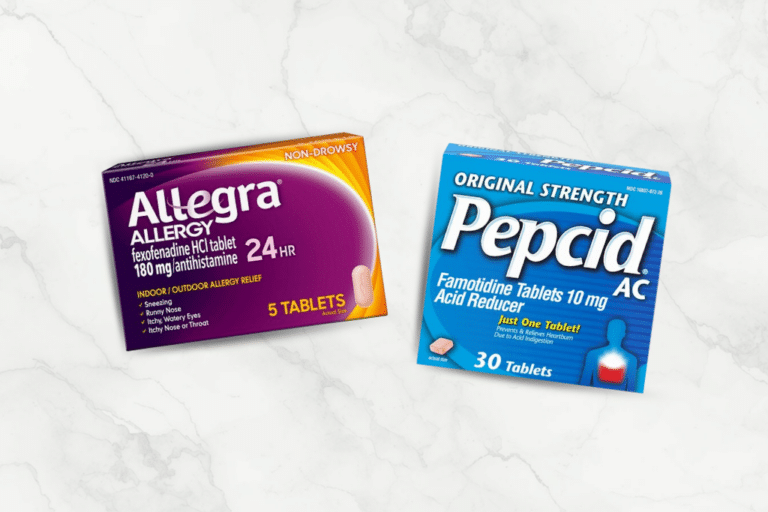
Well, I’m not on TikTok much because it’s just not my playground. But last week, a friend forwarded me a video of an influencer shaking her Pepcid and Allegra bottles as if she’d just found the Holy Grail. And I’ll admit, I had not heard anything about using these meds for menopause. This video got 4 MILLION views. So, down the rabbit hole I went as any good pharmacist would do.
Now, this trend didn’t come out of nowhere. Women are using antihistamines because… they’re actually helping some of them.
Hot flashes calm down. Sleep improves. Anxiety eases. Skin feels less reactive.
That’s not random. That’s physiology. In women who actually have a histamine issue.
And there’s the problem, not everyone does.
So let’s break it down.
First, What Is Histamine (And Why Should You Care)?
Histamine is a chemical your body makes naturally.
It plays a role in:
- Immune response
- Digestion
- Brain function
- Hormone signaling
You need it.
But like most things in the body, balance matters.
The Estrogen–Histamine Connection
Here’s the piece most women are miss:
Estrogen and histamine feed off each other.
Estrogen increases histamine release.
Histamine stimulates more estrogen production.
That’s a loop.
Now think about perimenopause.
Hormones aren’t declining in a smooth line.
They’re fluctuating like a rollercoaster.
So what happens?
- Estrogen spikes → histamine spikes
- Histamine spikes → more estrogen activity
- Symptoms go wild
This is why some women feel:
- More reactive to foods
- More anxious
- More inflamed
- More sensitive overall
Histamine, PMDD, and Mood Swings
If you’ve ever had:
- Severe PMS
- PMDD
- Mood swings that feel out of proportion
Histamine may be involved.
Histamine affects neurotransmitters like:
- Dopamine
- Serotonin
So when histamine is high, mood stability drops.
That “I don’t feel like myself” feeling?
Not always just hormones.
Mast Cells: The Hidden Player
Now let’s add another layer.
Mast cells are immune cells that release histamine.
When they’re calm, no problem.
When they’re triggered? They dump histamine into your system.
This can lead to:
- Flushing
- Heart palpitations
- Anxiety
- GI symptoms
- Headaches
And here’s the kicker: Estrogen can activate mast cells. So again, hormones and immune response are tightly linked. On the other side of the equation, progesterone stabilizes mast cells, so falling levels of this allow the mast cells to become unstable.
Where the Gut Comes In (This Is Huge)
If you take nothing else from this, take this:
Your gut controls histamine clearance.
You break down histamine using an enzyme called DAO (diamine oxidase), which is produced in the gut. If your gut is off, you don’t clear histamine well. That means histamine builds up.
And symptoms show up everywhere.
This aligns with what we see clinically:
- Gut imbalances → increased inflammation
- Inflammation → immune activation
- Immune activation → more histamine
There’s also emerging research connecting gut health to systemic issues like bone health and inflammation, reinforcing how interconnected these systems are.
Add to this a genetic component that controls DAO activity and it’s a potential recipe for a midlife mess.
This isn’t just about allergies. This is whole-body physiology.
Symptoms of Histamine Intolerance (It’s Not Just Hives)
Histamine intolerance isn’t always obvious.
Common symptoms include:
- Hot flashes
- Night sweats
- Anxiety or panic feelings
- Insomnia
- Headaches or migraines
- Flushing
- Heart palpitations
- Brain fog
- Bloating or diarrhea
- Itchy skin (without rash)
- Food sensitivities (especially wine, aged cheese, leftovers)
- Worsening symptoms around ovulation
Sound familiar? The problem is that many of the symptoms on this list can overlap with cortisol dysregulation or thyroid problems. So how do we tease this out?

Want to create a custom longevity health plan?
You’re in the right place.
I can help you with a functional approach to midlife women’s health including hormone balance, gut health, autoimmune issues, bone health, heart health and more!
What Are H1 and H2 Blockers?
Before we go further, let me explain. Histamine works by attaching to receptors throughout your body. There are four types, but these are the big ones for this conversation:H1 receptors
Found in:- Skin
- Brain
- Airways
- Itching
- Hives
- Anxiety
- Sleep disruption
H2 receptors
Found in:- Stomach lining
Why H1 + H2 Blockers “Work” (Short-Term)
The drugs in the TikTok craze work because they reduce histamine signaling and calm symptoms down if they are caused by histamine. But they don’t fix the underlying issues. They just block the message.H1 blockers (Benadryl, Allegra, Zyrtec, Claritin)
Using these on a long-term basis isn’t a great plan because you may just be trading one problem for another. First-generation antihistamines like Benadryl can be very sedating, cause brain fog, and actually have some data that suggest they can cause memory issues. The newer ones are less sedating (although my personal experience suggests that Zyrtec is pretty sedating).H2 blockers (Pepcid, Zantac, Tagamet)
H2 blockers like Pepcid (famotidine) reduce stomach acid, which you actually need. As you age, decreased stomach acid becomes more of a problem, and the H2 blockers just compound it. Long-term use may lead to:- Poor protein digestion
- Nutrient deficiencies (B12, magnesium, iron)
- Increased risk of infections like h. pylori
- Gut microbiome disruption like SIBO
So What Should You Do Instead?
This is where we shift from symptom control to root cause.1. Support your gut first
This is non-negotiable. You want to:- Identify dysbiosis or infections
- Reduce inflammation
- Support gut lining
2. Support histamine breakdown
Focus on:- DAO support (through nutrition and targeted supplementation)
- Nutrients like vitamin C and B6
3. Stabilize mast cells
This is key for many women. Look at:- Quercetin
- Luteolin
- Reducing triggers (stress, alcohol, certain foods)
4. Address hormone imbalance
You cannot ignore this piece. If estrogen is fluctuating wildly, histamine will follow. Progesterone is a natural mast cell stabilizer and the first hormone to fall in perimenopause, so supplementation of this may help. This is where personalized hormone work matters.5. Clean up your diet (strategically)
Not forever restrictive. But temporarily:- Reduce high-histamine foods
- Avoid leftovers (histamine builds over time)
- Watch alcohol (big trigger)
6. Manage stress
Stress activates mast cells, which increases histamine. And suddenly, you are allergic to stress! It’s all connected.Bottom Line
If antihistamines are helping you, that’s a clue. Not a solution. Your body is telling you:- There’s inflammation
- There’s imbalance
- There’s something upstream that needs attention
Your best next step…
If you’re dealing with:- unpredictable symptoms
- “random” reactions
- worsening midlife changes
Dr. Anna Garrett is a menopause expert and Doctor of Pharmacy. She helps women who are struggling with symptoms of perimenopause and menopause find natural hormone balancing solutions so they can rock their mojo through midlife and beyond. Dr. Anna is the author of Perimenopause: The Savvy Sister’s Guide to Hormone Harmony. Order your copy at www.perimenopausebook.com.
Dr. Anna is available for 1-1 consultations. Find out more at www.drannagarrett.com/lets-