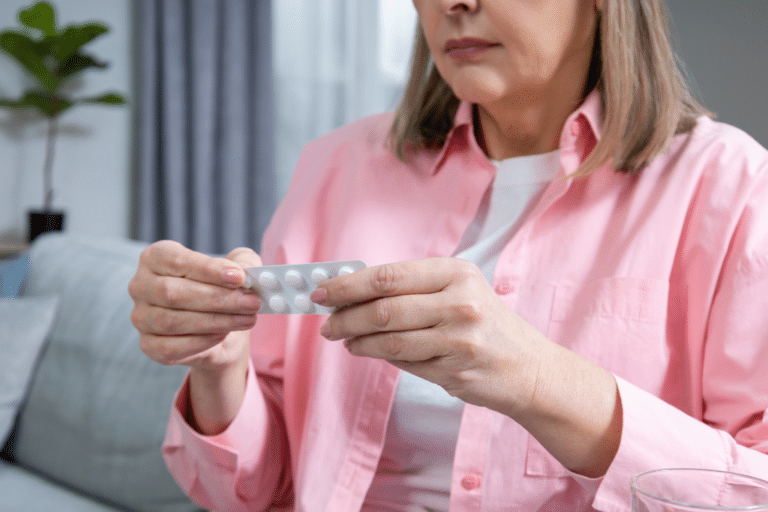
Choosing an estrogen product can feel like menopause roulette.
You’ve got pills, patches, gels, sprays, vaginal creams, tablets, rings, injections, troches, and pellets. Here’s the good news: you do not need a pharmacy degree to sort it all out. You just need to understand the basics so you can ask better questions and avoid getting stuck with a form that doesn’t fit your body or your life.
Hormone therapy remains the most effective treatment for hot flashes and night sweats, and it also helps with genitourinary syndrome of menopause, which includes vaginal dryness, burning, pain with sex, and some urinary symptoms. But it helps with many other things as well. Insomnia, joint pain, bone health, mood, skin health and even itchy ears (among other things) all respond to estrogen when used correctly.
So let’s walk through the main options.
1. Oral estrogen pills
This is the OG of estrogen options. Fortunately, it can now be had in bioidentical forms and not just processed from horse urine (Google Premarin; you’ll see). Easy to prescribe. Easy to take. And it’s usually the cheapest.
Pros
- Simple and familiar
- Easy dose changes
- Usually the most budget-friendly systemic option
- Lowers LDL cholesterol and lipoprotein a
Generic oral estradiol is often very affordable. GoodRx lists some generic oral estradiol prices as low as about $10 a month, depending on the dose and pharmacy. Cost Plus has it for $6.04. It’s hard to be that price.
Cons
Oral estrogen is processed through the liver. This can alter your body’s clotting factors which increases the risk of blood clots, heart attacks and strokes. The forms of estrogen that go through the skin do not do this. That matters. Oral therapy may also be less appealing if you have a history of blood clots, clotting disorders, migraine with aura, high triglycerides, certain liver issues, or gallbladder concerns. There are safer options.
Troubleshooting
If you feel nauseated, try taking it with food. If your breasts feel sore, you feel puffy, or your headaches ramp up, your dose may be too high. If your symptoms are still miserable, your dose may be too low or this may just not be the best route for you.
2. Transdermal estrogen patches
Patches deliver estrogen through the skin. For many women, this is a sweet spot between effective and practical. They are generally changed once or twice a week depending on the brand.
Pros
- Bypasses first-pass liver metabolism
- Often a better choice when clot risk or migraines are a concern
- Easy to stop or adjust
- Convenient
The Menopause Society says transdermal routes and may decrease the risk of venous thromboembolism and stroke. ACOG also notes that patches, sprays, and rings may pose less risk than pills taken by mouth.
Patch prices vary a lot. Some generic patch products start around $23 to $30 a month, while others are more like $40 to $60+ depending on brand and strength. There have also been issues with supply shortages recently, so ask your pharmacy how often this is an issue for them. CVS appears to have the worst problems with shortages.
Cons
- Adhesive irritation
- Some patches do not stick well
- Sweat, lotion, and summer weather can cause them to fall off
- Hot tub use can cause the estrogen to be released faster
- A recent study showed that about 20% of women do not absorb estrogen well from the patch. Read that here: https://pubmed.ncbi.nlm.nih.gov/39689249/
Troubleshooting
Apply to clean, dry skin. No lotion underneath. Rotate sites. If it keeps peeling off, ask for a different brand because the adhesive really does matter. If symptoms come back before change day, you may need a stronger patch or a different schedule. Do not cut patches without talking to your pharmacist. For some brands it’s OK, others not so much depending on the way the estrogen is stored in the patch.
3. Estrogen gels and sprays
These are also transdermal forms that require daily use.
Pros
- Also bypasses the liver
- Helpful if you hate or can’t tolerate patches
- Flexible dosing
GoodRx lists some estradiol gel products around $32 to $42 a month, while others are much pricier, ranging from about $75 to $190+ per month depending on brand. Evamist spray is often around $75.
Cons
- Daily use, so you have to remember it
- Needs time to dry
- Can transfer to people or pets if you don’t let it dry correctly
Troubleshooting
Apply it exactly where directed. Let it dry fully before dressing. Wash your hands. Keep partners, kids, and pets away from the site until it’s dry. If your symptoms are still a problem, your dose may be too low or you may absorb a patch better.

Want to create a custom longevity health plan?
You’re in the right place.
I can help you with a functional approach to midlife women’s health including hormone balance, gut health, autoimmune issues, bone health, heart health and more!
4. Vaginal estrogen: cream, tablet, insert, ring
This is where women get mixed up all the time.
Low-dose vaginal estrogen is usually for local symptoms, not whole-body symptoms. So if your biggest issue is vaginal dryness, burning, pain with sex, or urinary symptoms, this can be a great option. If your biggest issue is any of the other symptoms I mentioned, this is usually not enough on its own. The Menopause Society says vaginal estrogen may be used at any age and for extended duration, if needed. It is also safe for women after breast cancer treatment.
Vaginal Estrogen Cream
Pros
- Very effective for local symptoms
- Flexible dosing
- Often cheaper than some other vaginal products
Generic vaginal estradiol cream can range from about $17 to $80+ per month, depending on how much you use and where you fill it.
Cons
- Messy
- Applicators are not exactly glamorous. Your finger is a better choice. Really.
- Easy to underuse because life gets busy
Troubleshooting
Use it consistently. Bedtime is usually easiest. If you hate the mess, switch to a tablet or ring.
Vaginal tablet or insert
Pros
- Less messy than cream
- Good for dryness and irritation
Vaginal tablet products such as Vagifem often run around $80+ per month with discounts.
Cons
- More expensive than some creams
- Still requires regular use
Troubleshooting
If it feels like nothing is happening, give it time and make sure you’re using the loading schedule correctly. That’s daily for 2 weeks, then twice a week.
Vaginal ring
There are local and systemic rings, so don’t lump them together. Estring is a local vaginal product. Femring is systemic and acts more like whole-body estrogen.
Pros
- Very convenient
- Less frequent dosing
- Good option if you don’t want daily or twice-weekly fuss
Estring can cost around $249 for 90 days, which works out to roughly $83 a month. Femring can cost $800+, so yes, that can drain your wallet fast.
Cons
- Expensive
- Some women don’t like insertion or removal
- Easy to get confused about whether your ring is local or systemic
Troubleshooting
If it feels uncomfortable, placement may be the issue. If you’re using a local ring and wondering why your hot flashes still rage, that’s because it is doing a different job.
5. Estrogen injections
Estrogen injections can be a good solution for women who want convenience or find that transdermal products don’t get their levels high enough.
Pros
- Less frequent dosing
- Helpful for some women who do not do well with other routes
Estradiol cypionate and estradiol valerate are often dosed weekly or twice a week. Estradiol valerate can cost around $47 to $52 per vial, while Depo-Estradiol can be more like $200 to $240+ per vial. The monthly cost depends on dose and how long that vial lasts.
Cons
- Needles
- Peaks and troughs
- Can be harder to dial in smoothly
Troubleshooting
If you feel great right after the shot and then like garbage before the next one, the interval may be too long. If headaches, breast tenderness, or mood swings show up after the shot, you may be getting too much at once.
6. Pellets
Pellets get marketed like they’re the answer to everything. I am not buying that. What they are is an easy way to make doctors’ offices mucho money. If you’re on pellets and love them, please don’t come for me. They are great for some women!
Pellets are inserted under the skin and slowly release hormones over time. They sound convenient, but ACOG says compounded bioidentical menopausal hormone therapy should not be routinely prescribed when FDA-approved products exist. I’m not buying this either because compounding pharmacies have standards AND the active ingredient is indeed FDA approved. But they are still not my go-to recommendation for the reasons just mentioned.
Pros
- No daily or weekly reminder
- Some women like the convenience
Cons
- Usually compounded
- Hard to adjust once inserted
- If the dose is too high, you cannot undo it quickly
- Can experience peaks and troughs
- Often expensive and not covered by insurance
Pellet pricing varies widely by clinic and region, but it often runs several hundred dollars every few months. Insurance coverage is hit or miss at best.
Troubleshooting
This is the problem. Troubleshooting pellets is limited. If the dose is off, you may be stuck waiting it out. That is one big reason many experts prefer routes you can actually adjust. If you want to try pellets, make sure your dose is dialed in for a while before switching over. Pellets can be combined with testosterone.
7. Troches
Troches are little lozenges that dissolve in the mouth and is absorbed through the tissues of your mouth. They are usually compounded.
Pros
- Easy to use
- No patch adhesive
- No injection
Cons
- Usually compounded
- Variable absorption
- Less standardization
- Harder to know if you’re getting consistent dosing
- Often more expensive than FDA-approved options
Troubleshooting
If you’re getting symptom swings, headaches, breast tenderness, or you just feel all over the place, inconsistent absorption may be part of the problem. If you need a cleaner, more predictable form, FDA-approved oral, transdermal, or vaginal products usually make more sense.
Cost varies a lot by compounding pharmacy, formula, and region, but troches are often more expensive than generic FDA-approved oral estrogen and commonly run dozens to low hundreds of dollars per month. Because prices vary so much by pharmacy, it’s smart to get the exact quote before you say yes. This estimate is based on the fact that troches are compounded rather than mass-manufactured, not on a single national cash price source.
So which estrogen form is best for you?
Here’s the TL;DR version:
- Hot flashes and night sweats: pill, patch, gel, spray, sometimes injection
- Vaginal dryness and urinary symptoms: vaginal cream, tablet, insert, or ring
- Higher clot risk or liver concerns: transdermal usually deserves a serious look
- Need easy dose adjustment: pill, patch, gel, or spray
- Need cheaper: generic oral estradiol usually wins
- Want “set it and forget it”: ring may be a better bet than pellets for a lot of women
And one more thing.
If your estrogen “isn’t working,” that does not always mean estrogen is the wrong choice.
Sometimes the dose is wrong.
Sometimes the route is wrong.
Sometimes you’re using a local product for a systemic problem.
Sometimes, nobody explained the difference between ALL the choices.
You didn’t fail.
You just need the right tool for the job.
References
American College of Obstetricians and Gynecologists. (2013). Postmenopausal estrogen therapy route of administration and risk of venous thromboembolism. https://www.acog.org/clinical/clinical-guidance/committee-opinion/articles/2013/04/postmenopausal-estrogen-therapy-route-of-administration-and-risk-of-venous-thromboembolism
American College of Obstetricians and Gynecologists. (2023). Compounded bioidentical menopausal hormone therapy. https://www.acog.org/clinical/clinical-guidance/clinical-consensus/articles/2023/11/compounded-bioidentical-menopausal-hormone-therapy
American College of Obstetricians and Gynecologists. (n.d.). Hormone therapy for menopause. https://www.acog.org/womens-health/faqs/hormone-therapy-for-menopause
Glynn S, et al. The range and variation in serum estradiol concentration in perimenopausal and postmenopausal women treated with transdermal estradiol in a real-world setting: a cross-sectional study. https://pubmed.ncbi.nlm.nih.gov/39689249/
GoodRx. (2026). Climara prices, coupons & savings tips. https://www.goodrx.com/climara
GoodRx. (2026). Delestrogen prices, coupons & savings tips. https://www.goodrx.com/delestrogen
GoodRx. (2026). Depo-Estradiol prices, coupons & savings tips. https://www.goodrx.com/depo-estradiol
GoodRx. (2026). Divigel prices, coupons & savings tips. https://www.goodrx.com/divigel
GoodRx. (2026). Estring prices, coupons & savings tips. https://www.goodrx.com/estring
GoodRx. (2026). Estrace prices, coupons & savings tips. https://www.goodrx.com/estrace
GoodRx. (2026). Estrogel prices, coupons & savings tips. https://www.goodrx.com/estrogel
GoodRx. (2026). Evamist prices, coupons & savings tips. https://www.goodrx.com/evamist
GoodRx. (2026). Femring prices, coupons & savings tips. https://www.goodrx.com/femring
GoodRx. (2026). How much do estrogen products for menopause cost? https://www.goodrx.com/conditions/estrogen-replacement/how-much-does-estrogen-cost
GoodRx. (2026). 11 menopause treatments: Medications, topicals, patches, and more. https://www.goodrx.com/conditions/menopause/treatments-and-supplements
GoodRx. (2026). Vagifem prices, coupons & savings tips. https://www.goodrx.com/vagifem
Pfizer Medical Information. (n.d.). DEPO-ESTRADIOL dosage and administration. https://www.pfizermedical.com/depo-estradiol/dosage-admin
The Menopause Society. (2022). The North American Menopause Society releases its 2022 hormone therapy position statement. https://menopause.org/wp-content/uploads/press-release/ht-position-statement-release.pdf
National Academies of Sciences, Engineering, and Medicine. (2020). Compounded bioidentical hormone preparations. In The clinical utility of compounded bioidentical hormone therapy. https://www.ncbi.nlm.nih.gov/books/NBK562866/
Australasian Menopause Society. (n.d.). Bioidentical custom compounded hormone therapy. https://www.menopause.org.au/hp/information-sheets/bioidentical-hormones-for-menopausal-symptoms
Dr. Anna Garrett is a menopause expert and Doctor of Pharmacy. She helps women who are struggling with symptoms of perimenopause and menopause find natural hormone balancing solutions so they can rock their mojo through midlife and beyond. Dr. Anna is the author of Perimenopause: The Savvy Sister’s Guide to Hormone Harmony. Order your copy at www.perimenopausebook.com.
Dr. Anna is available for 1-1 consultations. Find out more at www.drannagarrett.com/lets-