

What women need to know about long-term use, menopause-related mood symptoms, and tapering without making a mess of things
A client recently told me she’d been taking the same antidepressant for more than ten years. It was prescribed in her early forties when anxiety, poor sleep, irritability, and emotional overwhelm seemed to show up all at once. No one mentioned perimenopause. They handed her a prescription and sent her on her way.
Years later, she started hormone replacement therapy. Her hot flashes settled down. She slept better. Her mood felt steadier, and she no longer woke up feeling as if her nervous system had spent the night plugged into an electrical socket.
Then she asked the obvious question: “Do I still need the antidepressant?”
The honest answer was maybe. Antidepressants can be very helpful and, for some people, lifesaving. They can also remain on a medication list for years simply because no one has taken the time to review them. Automatic refills are not the same thing as thoughtful care.
What Long-Term Antidepressants Actually Change
SSRIs include medications such as sertraline, escitalopram, fluoxetine, paroxetine, and citalopram. SNRIs include medications like Effexor and Cymbalta. Both change the way serotonin is handled between nerve cells, although SNRIs also affect norepinephrine as well. But the story is much bigger than “more serotonin equals better mood.” If it were that simple, these medications would work immediately. They don’t.
Over time, the brain and nervous system adjust to the medication. Receptors change their sensitivity. Feedback systems shift. Stress-response pathways and brain connections adapt. Those changes are part of how the medication may help, but at the end of the day, your body wants to stay in balance and will decrease the amount of serotonin that is made naturally.
The nervous system gets used to having the drug around. Pull it away too quickly and the body may protest loudly. That is withdrawal, not weakness, addiction, or proof that someone is destined to take the medication forever.
And while we’re here, the old “chemical imbalance” explanation needs to retire. Depression is not simply a serotonin shortage. Mood is shaped by hormones, sleep, trauma, inflammation, genetics, physical health, relationships, stress, and a whole lot more.
What Can Show Up With Long-Term Use?
Many people take antidepressants for years and do well. Others notice side effects that become more obvious with time. These may include:
- Lower libido or other sexual side effects
- Emotional blunting or feeling a little too flat
- Weight, appetite, fatigue, or sleep changes
- Sweating or digestive symptoms
- Low sodium, especially in older adults
- A harder time stopping them than anyone warned them about
Of course, menopause can also cause low libido, fatigue, poor sleep, brain fog, and mood changes. So can thyroid problems, low iron, sleep apnea, alcohol, stress, and depression itself. The answer is not to blame everything on the antidepressant. The answer is to stop looking at each symptom in a separate little box.
Was It Depression, Perimenopause, or Both?
Perimenopause can be rough on the brain. Fluctuating estrogen affects serotonin, dopamine, sleep, temperature control, and the stress response. Add night sweats and 3 a.m. wake-ups, and even a normally calm woman can start feeling anxious, irritable, foggy, and completely unlike herself.
Some women are prescribed antidepressants for hot flashes, especially if there’s a history of a condition that causes her doctor to say, “no hormones for you”. We now know that there are VERY few reasons that a woman can’t be on hormones, but that’s another article. Others get an antidepressant after mentioning panic, insomnia, palpitations, rage, or low mood without anyone asking whether hormones might be part of the picture. The medication may have helped, but that doesn’t mean the original situation should never be revisited.
HRT can improve mood symptoms in some women, especially when those symptoms began during the menopause transition and came along with hot flashes and poor sleep. But HRT is not a universal treatment for depression, and it does not automatically replace psychiatric medication.
Feeling Better on HRT Is a Reason to Reassess, Not to Play Pharmacist at Home
Here is where things can go sideways. A woman starts estrogen, sleeps better, feels calmer, and decides she is done with her SSRI. She cuts the dose in half or starts taking it every other day.
A few days later, she is dizzy, nauseated, anxious, tearful, wide awake at 2 a.m., or getting those strange electric-shock sensations people call brain zaps. She assumes her depression is back. Or she gets scared and goes back on her old dose. OR she decides the HRT stopped working. All of these thoughts are likely the incorrect thought process.
The more likely explanation is that the dose dropped too fast.
The smarter move is to get stable first. Let the HRT plan settle in. Work on sleep. Check the thyroid, iron, B12, vitamin D, alcohol use, stress load, and other medications. Change one thing at a time. Otherwise, nobody knows what helped, what hurt, or what caused the train to leave the tracks.
Want to create a custom longevity health plan?
You’re in the right place.
I can help you with a functional approach to midlife women’s health including hormone balance, gut health, autoimmune issues, bone health, heart health and more!
Who Probably Should Not Start a Taper Right Now?
A taper may need to wait if someone is in the middle of a depressive episode, dealing with severe anxiety or insomnia, facing a major crisis, misusing substances, or making several hormone and medication changes at once. Recent suicidal thoughts, mania, psychosis, or psychiatric hospitalization require close medical oversight.
A history of repeated or severe depression does not automatically mean tapering is off the table. It does mean the plan needs more thought, more support, and less bravado.
A Better Way to Reassess the Medication
- Go back to the beginning. Why was the medication prescribed in the first place? Major depression? Anxiety? Hot flashes? Insomnia? A terrible life season?
- Ask what it is doing now. Is it clearly helping? Are side effects affecting sex, energy, weight, sleep, or emotional range?
- Look at relapse risk. How many prior episodes were there? How severe were they? What happened during past taper attempts?
- Check the rest of the picture. HRT response, sleep, thyroid, iron, B12, vitamin D, alcohol, trauma, stress, and other medications all belong in the conversation.
- Create a baseline. Track mood, anxiety, sleep, energy, physical symptoms, and ability to function before changing the dose.
- Make one change at a time. Your nervous system does not need HRT changes, a new supplement stack, and an antidepressant taper all in the same week.
- Build the taper with the prescriber and pharmacist. A good plan includes what to do if symptoms show up, not just a calendar of dose reductions.
Why Tapering Is Not a DIY Project
There is no universal taper schedule that works for every person, every medication, and every dose. Someone who took an SSRI for six months may have a very different experience from someone who has taken paroxetine for fifteen years.
A safe taper usually means reducing in stages and waiting until symptoms settle before reducing again. The cuts often need to get smaller near the end. Dropping five milligrams from forty is not the same as dropping five milligrams from five, although plenty of taper plans treat those two changes as if they are equal.
Some people taper over weeks. Others need months or longer. Liquid medication, smaller tablet strengths, carefully split tablets, or compounded doses may be needed. Skipping days is usually a lousy strategy because it sends medication levels up and down.
Withdrawal or Depression Coming Back?
This is the part that confuses almost everyone. Withdrawal can cause anxiety, low mood, crying, irritability, insomnia, and trouble concentrating. In other words, it can look an awful lot like the original problem returning.
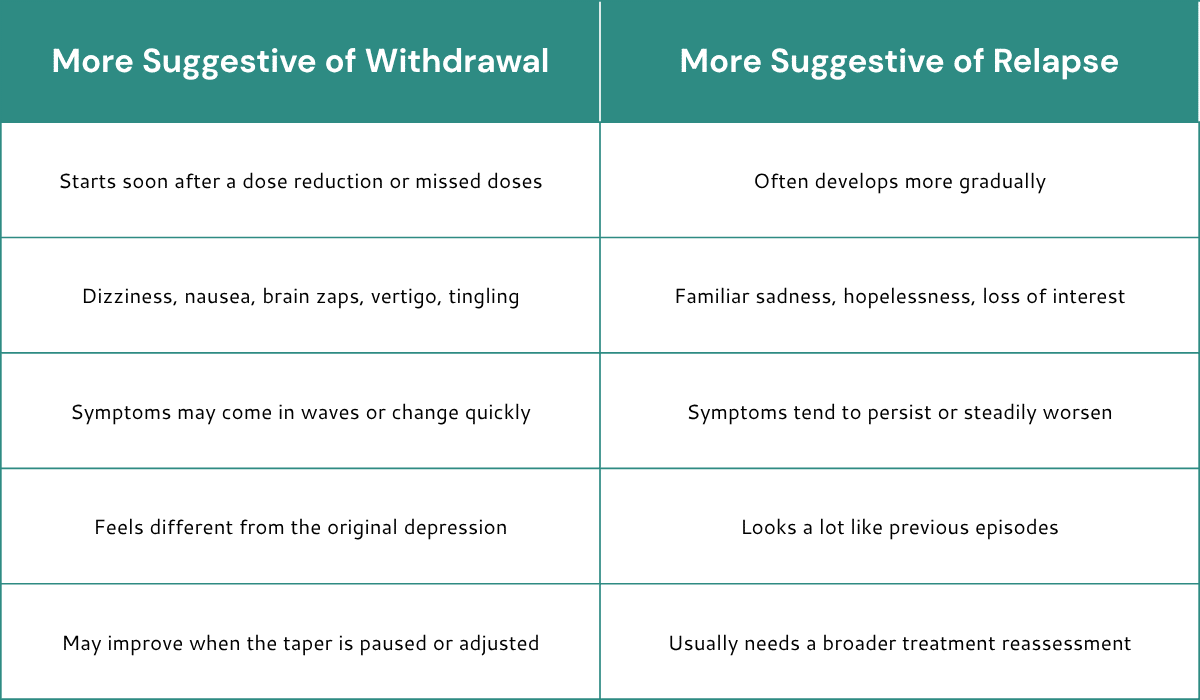
These are clues, not a home diagnostic test. Withdrawal and relapse can happen at the same time. Suicidal thoughts, mania, psychosis, severe agitation, or an inability to function need urgent professional attention, no matter what caused them.
Where a Pharmacist Can Save You a Lot of Grief
As a pharmacist, I can tell you that some taper plans look perfectly reasonable on paper and fall apart the minute someone tries to fill the prescription.
The next tablet strength may be too big a drop. The tablet may not be safe to split. An extended-release product may not be alterable. A liquid may need careful conversion, or a compounding pharmacy may be the only practical way to make smaller doses.
A pharmacist can review the dosage form, half-life, interactions, available strengths, and whether the taper can actually be carried out as written. The prescriber may need to authorize each change, depending on the setting and state law. This works best as a team effort, not a solo mission.
Still Taking an Antidepressant No One Has Revisited?
If your antidepressant was started during perimenopause and it has been years since anyone asked whether you still need it, that deserves a closer look.
Not because antidepressants are bad. And not because HRT magically replaces them. But because “we’ve always done it this way” is not a medication strategy.
During a Clarity Call, we’ll look at the whole picture: why the medication was started, what has changed since then, how you are responding to HRT, and what else may be affecting your mood, sleep, energy, and anxiety.
I will not tell you to stop your medication, and I definitely will not hand you a cookie-cutter taper pulled from the internet. Any medication change needs to be coordinated with the doctor who prescribed it.
What I can do is help you connect the dots, get clearer on what may be hormonal, and make sure you walk into your next appointment asking much better questions than, “So…do I still need this?”
Book your Clarity Call: https://l.bttr.to/sppG1
Final Thoughts
If an antidepressant helped you through a hard season, you did not make a mistake by taking it. If you feel well now, that does not automatically mean you need to stay on it forever.
The goal is not to get everyone off antidepressants. The goal is to make sure every medication is still earning its place.
But please do not turn tapering into a weekend experiment. Your nervous system adapted over time. Give it the planning, patience, tiny dose changes, and professional support it may need to adapt again.

Frequently Asked Questions
How long should I wait after starting HRT before considering a taper?
There is no magic number. Ideally, your hormone plan, sleep, mood, and physical symptoms should be reasonably stable before you make another major change.
Are withdrawal symptoms proof that I still need the medication?
No. They show that your nervous system reacted to the dose reduction. They do not automatically prove the original depression has returned.
Can I just cut the tablet in half?
Sometimes, but not always. Some tablets should not be split, and a 50 percent drop may be way too large even when splitting is technically allowed. Ask your pharmacist.
What if my first taper attempt goes badly?
That does not mean you can never taper. The plan may have been too fast, the dose changes too large, or the timing terrible. Pause, regroup, and get better support.
References
Fava, G. A., Benasi, G., Lucente, M., Offidani, E., Cosci, F., & Guidi, J. (2018). Withdrawal symptoms after selective serotonin reuptake inhibitor discontinuation: A systematic review. Psychotherapy and Psychosomatics, 87(4), 195–203.
Gordon, J. L., Rubinow, D. R., Eisenlohr-Moul, T. A., Leserman, J., & Girdler, S. S. (2018). Efficacy of transdermal estradiol and micronized progesterone in the prevention of depressive symptoms in the menopause transition: A randomized clinical trial. JAMA Psychiatry, 75(2), 149–157. https://doi.org/10.1001/jamapsychiatry.2017.3998
Haddad, P. M. (2001). Antidepressant discontinuation syndromes. Drug Safety, 24(3), 183–197.
National Institute for Health and Care Excellence. (2022). Depression in adults: Treatment and management (NICE Guideline NG222).
Royal College of Psychiatrists. (n.d.). Stopping antidepressants.
Schmidt, P. J., Ben Dor, R., Martinez, P. E., et al. (2015). Effects of estradiol withdrawal on mood in women with past perimenopausal depression: A randomized clinical trial. JAMA Psychiatry, 72(7), 714–726.
Soares, C. N., Almeida, O. P., Joffe, H., & Cohen, L. S. (2001). Efficacy of estradiol for the treatment of depressive disorders in perimenopausal women: A double-blind, randomized, placebo-controlled trial. Archives of General Psychiatry, 58(6), 529–534. https://doi.org/10.1001/archpsyc.58.6.529
Sørensen, A., Juhl Jørgensen, K., & Munkholm, K. (2022). Description of antidepressant withdrawal symptoms in clinical practice guidelines on depression: A systematic review. Journal of Affective Disorders, 316, 177–186.
Dr. Anna Garrett is a menopause expert and Doctor of Pharmacy. She helps women who are struggling with symptoms of perimenopause and menopause find natural hormone balancing solutions so they can rock their mojo through midlife and beyond. Dr. Anna is the author of Perimenopause: The Savvy Sister’s Guide to Hormone Harmony. Order your copy at www.perimenopausebook.com.
Dr. Anna is available for 1-1 consultations. Find out more at www.drannagarrett.com/lets-