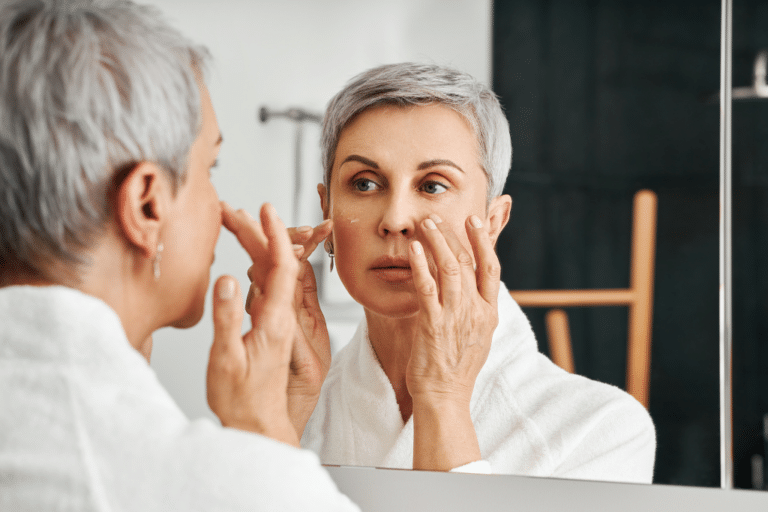
- Does estrogen on facial skin work? Sometimes, in some studies, for some women.
- Does it erase wrinkles like magic? No.
- Is it side-effect-free? Also no.
- Should you DIY prescription estrogen on your face? Not without knowing exactly what you are using and what to watch for.
First, what people mean by “estrogen face cream”
When someone says “estrogen on the face,” they could be talking about three totally different things:- Prescription estrogen (estradiol, estriol, estrone) used off label on facial skin
- Compounded hormone creams marketed for facial aging
- Over-the-counter skincare that contains estriol or estradiol.
- Over-the-counter products that contain phytoestrogens.
Why this “estrogen for your face” trend exists at all
Estrogen matters in skin. When estrogen is low, many women notice more dryness, thinning, fine wrinkling, and slower healing. A review on estrogen and skin aging explains how estrogen influences keratinocytes, dermal fibroblasts, and collagen, among other effects. So yes, the biology is real. The question is whether rubbing estrogen on facial skin gives meaningful, visible benefits without unwanted downsides.What the data says: benefits are possible, but not guaranteed
The encouraging study: A small clinical trial in postmenopausal women already on systemic estrogen therapy added topical estrogen to facial skin for 16 weeks. Researchers found increased epithelial and dermal thickness and a significant increase in collagen, and estradiol blood levels did not significantly increase in that study. That sounds great, but keep your expectations grounded:- It was a small study.
- These women were already on systemic estrogen.
- The outcomes were tissue changes, not “you look 10 years younger.”
What about systemic absorption? Can it “get into your system”?
Let’s be very clear: skin is not a sealed lid. Medications absorb through skin. That is literally why transdermal hormone therapy exists. In one study, researchers looked at women applying dermal estrogen ointment to the face daily for three months (either low-dose estradiol or estriol) and monitored vaginal smears and serum hormones. They did not find significant changes in serum hormone levels or vaginal smear appearance during treatment. That is reassuring, but it is not a blank check. Different molecules, doses, bases, frequencies, and skin barriers can behave differently. And if you are using compounded products, potency can vary. Also, hormone transfer is not just internet paranoia. A Pharmacotherapy study found estradiol could be transferred to male partners after vigorous skin-to-skin contact with application sites from estradiol topical emulsion, with a statistically significant increase in partners’ serum estradiol (still below the upper limit of normal for men). The transference is also a concern for kids and pets. Now, most women are not rubbing estradiol emulsion on their legs and then having someone vigorously rub the application site. But the point stands: topical estrogen can move through skin and can transfer with contact.
Want to create a custom longevity health plan?
You’re in the right place.
I can help you with a functional approach to midlife women’s health including hormone balance, gut health, autoimmune issues, bone health, heart health and more!
Who should NOT experiment with estrogen cream on the face
If any of these apply to you, this is not a “try it and see” situation:
- History of estrogen-sensitive cancer (it may be OK, but ask your doc first)
- Unexplained vaginal bleeding now or in the past
- You are using a compounded hormone cream
- You are already on systemic hormone therapy and do not know your total exposure
- You are using tretinoin. Don’t layer these as the effect of both will be blunted. Use estrogen in AM and tretinoin at night.
If you are thinking, “But my friend does it and she’s fine,” cool. Your body is not your friend’s body.
The ingredient list: what women should watch for
This is where we get practical.
If you see these, it is actual hormone therapy (not skincare)
- Estradiol
- Estriol
- Estrone
- 17β-estradiol
- “Bioidentical estrogen” (often code for compounded estradiol or estriol)
If it contains these, treat it like medication. That means you should have a real conversation about whether it’s OK for you. And remember, just because something is over-the-counter doesn’t mean you shouldn’t think twice about it.
Lower-risk “estrogen-like” ingredients (not the same as hormones)
- Genistein and other soy isoflavones
- Red clover isoflavones
- Ingredients marketed to support estrogen signaling pathways (varies widely)
A review on estrogen-deficient skin discusses topical estrogen and topical isoflavones as non-systemic approaches studied for menopausal skin changes.
These products may help some women, but they are not guaranteed, and they are not interchangeable with prescription estrogen.
Marketing lies to ignore: There is no best estrogen face cream
- “No systemic absorption.”
- “Safe because it’s topical.”
- “Balances hormones through the skin.”
- “Bioidentical means no risks.”
- “Works like Botox.”
If hormones worked like Botox, dermatology would look very different.
What to watch for if you try it anyway
Stop and reassess if you notice:
- Breast tenderness
- Spotting or bleeding
- Headaches that feel hormonal
- Nausea, mood shifts, swelling
- Any new symptom that makes you think, “Wait, that’s weird.”
And I will say this loudly: postmenopausal bleeding is never something to ignore.
A smarter approach if your real goal is better skin
Before you jump to hormone experiments, start with what consistently works:
- Daily sunscreen (non-negotiable)
- A retinoid if tolerated (but don’t use it at the same time as your estrogen cream)
- Vitamin C or other evidence-based antioxidants
- Barrier support (ceramides, glycerin, hyaluronic acid)
Then, if you are still curious about estrogen-related approaches:
- Consider products designed for menopausal skin changes that are not straight-up hormones.
- If you are considering actual hormone therapy on facial skin, do it with clinician oversight and a plan.
Bottom line
Topical estrogen for facial aging is not pure nonsense, but it is also not a free-for-all beauty hack.
One small study suggests topical estrogen may improve skin thickness and collagen markers in postmenopausal women already on systemic estrogen. A larger randomized controlled trial using estrone cream on sun-exposed facial skin found no improvement in wrinkles or elasticity and showed increased MMP-1 expression, raising concerns in sun-damaged skin.
So, if you want my clinical take?
Your face is not a science project.
If you are going to try estrogen on facial skin, you need to know exactly what you are using, respect absorption, and watch for systemic signs of absorption like breast tenderness or spotting.
And if you want help sorting this out based on your history, your risk factors, and your goals, that is exactly the kind of “connect the dots” work I do. Let’s talk. You can schedule a consultation with me at www.drannagarrett.com/lets-talk.
References
Kainz, C., Gitsch, E., Stani, J., Breitenecker, G., Binder, M., & Schmidt, J. B. (1993). When applied to facial skin, does estrogen ointment have systemic effects? Maturitas.
Patriarca, M. T., Goldman, K. Z., Dos Santos, J. M., & et al. (2007). Effects of topical estradiol on the facial skin collagen of postmenopausal women under oral hormone therapy: A pilot study. European Journal of Obstetrics & Gynecology and Reproductive Biology.
Stevenson, S., & Thornton, J. (2007). Effect of estrogens on skin aging and the potential role of SERMs. Clinical Interventions in Aging, 2(3), 283–297.
Taylor, M. B., et al. (2008). Absorption, bioavailability, and partner transfer of estradiol from a topical emulsion. Pharmacotherapy.
The Menopause Society. (2025, November 10). The Menopause Society comments on the FDA announcement on hormone therapy.
The Menopause Society. (n.d.). Menopause topics: Hormone therapy.
Yoon, H.-S., Lee, S.-R., & Chung, J. H. (2014). Long-term topical oestrogen treatment of sun-exposed facial skin in post-menopausal women does not improve facial wrinkles or skin elasticity, but induces matrix metalloproteinase-1 expression. Acta Dermato-Venereologica, 94(1), 4–8.
Rzepecki, A. K., Murase, J. E., Juran, R., Fabi, S. G., & McLellan, B. N. (2019). Estrogen-deficient skin: The role of topical therapy. International Journal of Women’s Dermatology.
Dr. Anna Garrett is a menopause expert and Doctor of Pharmacy. She helps women who are struggling with symptoms of perimenopause and menopause find natural hormone balancing solutions so they can rock their mojo through midlife and beyond. Dr. Anna is the author of Perimenopause: The Savvy Sister’s Guide to Hormone Harmony. Order your copy at www.perimenopausebook.com.
Dr. Anna is available for 1-1 consultations. Find out more at www.drannagarrett.com/lets-