What Changed in The US Dietary Guidelines, Why It Helps, and Who Needs to Personalize It
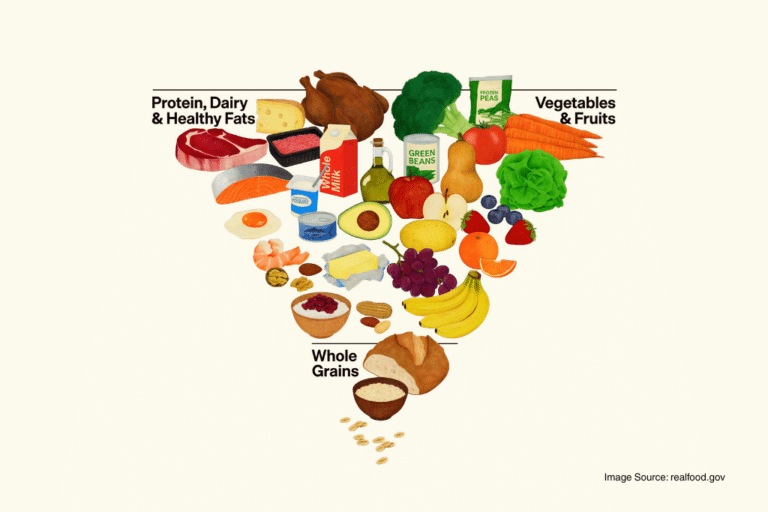
If your feed looks like people are grieving the death of the old food pyramid (again), you are not imagining things. The US Dietary Guidelines for Americans (2025–2030) are out, and they brought the pyramid back with a big headline: eat real food.
Cue the hand-wringing and pearl-clutching, because many interpreted these changes as an invitation to stuff yourself with ribeye, butter, and full-fat milk. Sure to bring on a heart attack!
Some of that worry is fair. Some of it is social-media noise. And some of it is simply the reality that a one-page graphic cannot cover the complexity of real humans with real labs, real symptoms, real schedules, and real medical histories.
Let’s walk through what actually changed, why many parts are genuinely beneficial, and who may need to tweak this guidance to support their hormones, gut, and long-term health rather than make them feel worse.
What Changed in The New Guidelines
1) The “pyramid” is inverted, and the message is simplified
For years, the public-facing visual was MyPlate. Now the government is leaning into a pyramid-style framework again and positioning it as a consumer tool (not just policy language). The core theme is consistent throughout: prioritize whole, minimally processed foods and dramatically reduce highly processed foods.
2) Protein is no longer treated like a side character
The new guidelines explicitly push higher daily protein targets, landing in the range of 1.2–1.6 grams of protein per kilogram of body weight per day. That is a meaningful jump from the old “minimum” mindset. Yes, the graphic shows a big steak at the top, but there’s a chicken right up there too. You choose.
For midlife women, this is not a small detail. Loss of muscle (and strength) accelerates with age, especially after menopause. Muscle is not just for aesthetics. It is your metabolic engine, your blood sugar buffer, your longevity savings account AND your ticket to staying out of the nursing home. Sounds good to me.
3) Full-fat dairy is back on the table
The guidance is friendlier to full-fat dairy, emphasizing versions without added sugar. This is a big shift from decades of low-fat everything messaging. Why the change? While studies have conflicting outcomes, there are some that suggest full-fat daily consumption results in better health outcomes.
4) Added sugar and highly processed foods get a stronger warning label
The new guidelines take a harder line on added sugars, and they call out highly processed foods more directly than previous versions. That includes specific “avoid” language for common ultra-processed snack and beverage categories. Hard to argue with that, as there is no recommended daily allowance of sugar.
5) Gut health gets a direct mention
This is one of the more interesting changes: the guidelines explicitly talk about the microbiome and mention fermented foods and high-fiber foods as supportive for gut diversity. That does not mean everyone should start eating kimchi three times a day. It does mean gut health is now officially part of the conversation.
6) Whole grains are still recommended, but the visuals and emphasis are debated
The written guidance still encourages fiber-rich whole grains and reducing refined carbs. But critics have pointed out that the visual emphasis may not match the text, which can confuse the public. Here’s what I think you need to know. There are few of us that couldn’t stand to increase our fiber. This is important because it feeds our beneficial gut microbes and helps move things along in our GI tract. Bowel regularity is one of the ways we excrete byproducts of hormone breakdown. It also helps you feel full longer and stabilizes blood sugar.
Why These Changes Can be Beneficial (Especially for Midlife Women)
Less processing, less metabolic chaos
If the new pyramid does nothing else but help women reduce highly processed foods, we would see wins in energy, cravings, mood stability, blood sugar, triglycerides, and even hot flashes for many women.
Ultra-processed diets tend to be engineered for overconsumption. That is not a moral failing. It is food design. Which means more sales and profits. A guideline that clearly pushes people back toward real meals is a step in the right direction.
Higher protein supports: muscle, metabolism, and hormones
Midlife women often feel like their body “stopped responding.” A big part of that is the combination of:
- less muscle
- more insulin resistance
- worse sleep
- higher stress load
- under-eating protein and micronutrients
More protein can improve satiety, reduce blood sugar swings, and support strength training adaptations. Translation: fewer crashes, fewer snack attacks, and more resilience.
Full-fat dairy can help some women feel more satisfied and steady
For some women, full-fat dairy improves satiety and makes breakfast actually work. If you tolerate dairy well, unsweetened Greek yogurt, cottage cheese, kefir, and aged cheeses can be easy protein wins.
The key phrase is “if you tolerate dairy well.” We will get there.
The gut-health inclusion is a big deal
Midlife is when many women notice new digestive issues, new food intolerances, and more inflammation. Calling out fermented foods and fiber as microbiome-supportive is a nudge toward foods that help your gut lining, immune regulation, and metabolic signaling.
But, and I say this lovingly: your gut is not a group project. What helps your friend might flare you.

Want to create a custom longevity health plan?
You’re in the right place.
I can help you with a functional approach to midlife women’s health including hormone balance, gut health, autoimmune issues, bone health, heart health and more!
What Might Not be Beneficial (or Needs Personalization)
This is where the internet tends to scream, “The guidelines are terrible,” or “The guidelines are perfect.” Real life is in the middle.
1) Chronic kidney disease (CKD) and higher protein
If you have moderate to advanced CKD (or you are at risk of progression), aggressive protein targets may not be appropriate. Kidney guidelines commonly recommend avoiding high protein intake in certain CKD stages and individualizing targets with your clinician or renal dietitian.
If you have any history of reduced eGFR, significant protein in the urine, or you have been told you have kidney disease, do not turn this into a protein contest.
2) Heart disease risk, high LDL, or ApoB issues with the “healthy fats” messaging
The guidelines still mention limiting saturated fat to 10% of calories, but they also list butter and beef tallow as options and visually elevate animal-based foods, which has raised concerns among cardiovascular experts.
If your LDL, ApoB, Lp(a), or coronary calcium score is not where you want it, your “healthy fats” plan should likely lean heavier on:
- olive oil
- nuts and seeds
- avocado
- fatty fish
- fiber-rich plants
And be more cautious with frequent high-saturated-fat choices like butter, heavy cream, and large portions of red meat.
3) Gut issues: IBS, SIBO, histamine intolerance, IBD
Fermented foods are not universally friendly. If you deal with:
- histamine reactions (headaches, flushing, hives, insomnia)
- SIBO (fermentation = symptoms)
- active IBD flares
…then “more fermented foods” may backfire. You may need a calmer approach: gently increase fiber, use cooked vegetables, choose low-FODMAP options temporarily, and rebuild tolerance strategically.
4) Autoimmunity and individual triggers
Autoimmune disease is not one-size-fits-all. Some women do fine with dairy and gluten. Some absolutely do not.
If you have Hashimoto’s, rheumatoid arthritis, psoriasis, lupus, or another autoimmune condition and you notice clear symptom patterns with certain foods, your best plan is not “follow the pyramid harder.” Your best plan is personalized nutrition with smart testing, symptom tracking, and a plan that supports immune regulation.
5) Diabetes and insulin resistance: carbs still matter, but type and timing matter more
The guidelines emphasize reducing refined carbs and added sugars, which is great. For women with insulin resistance or type 2 diabetes, the best results usually come from:
- prioritizing protein at meals
- choosing fiber-rich carbs (beans, lentils, intact whole grains, berries)
- pairing carbs with protein and fat
- strength training
If you try to follow the pyramid and end up with frequent refined carbs (even if they are “low fat”), your blood sugar will tell on you.
6) Eating disorder history or highly restrictive personalities
Any national guideline can become a permission slip for perfectionism. If you have a history of disordered eating, this is your reminder: the goal is nourishment and consistency, not food anxiety.
How I’d Translate This Into Real Life for Midlife Women
Here is the simplest “useful” version:
Build Every Meal With This Order
- Protein first (aim for 25–40g per meal for many women, individualized)
- Colorful plants (cooked if your gut is sensitive)
- Fiber-smart carbs (whole grains, beans, fruit as tolerated)
- Healthy fats (olive oil, avocado, nuts, seeds, plus some saturated fat if labs allow)
- Cut the ultra-processed extras (the sneaky stuff that drives cravings)
If You Want a Quick Self-Check
- Are you eating enough protein to maintain muscle?
- Are you getting fiber without wrecking your gut?
- Are your fats supporting your labs and your brain?
- Are added sugars and ultra-processed foods an “occasion” or a daily default?
That is the work.
Bottom Line
The newest guidelines get a lot right: real food, fewer ultra-processed foods, less added sugar, more attention to protein, and a nod to gut health.
But a national pyramid is not a prescription. If you have CKD, significant cardiovascular risk, diabetes, autoimmune disease, or gut conditions like IBS or SIBO, you deserve individualized targets and smarter food choices within the framework.
You are not “doing it wrong” if you need to personalize it. You are doing it like an adult woman who lives in a real body and has a brain.
If you want help translating these guidelines into a plan that fits your labs, symptoms, and life, schedule a consultation at www.drannagarrett.com/lets-talk.
References
American Heart Association. (2026, January 7). New dietary guidelines underscore importance of healthy eating.
Dietary Guidelines Advisory Committee. (2024). Scientific report of the 2025 Dietary Guidelines Advisory Committee.
Fang, Z., et al. (2024). Association of ultra-processed food consumption with all-cause mortality: A systematic review and meta-analysis. BMJ, 385, e078476.
Kennedy, R. F., Jr., & Rollins, B. L. (2026). Dietary Guidelines for Americans, 2025–2030. U.S. Department of Health and Human Services & U.S. Department of Agriculture.
Kidney Disease: Improving Global Outcomes (KDIGO). (2024). KDIGO 2024 clinical practice guideline for the evaluation and management of chronic kidney disease.
The Nutrition Source, Harvard T. H. Chan School of Public Health. (2026, January 9). Dietary Guidelines for Americans 2025–2030: Progress on added sugar, protein hype, saturated fat contradictions.
U.S. Department of Agriculture. (2026, January 7). Kennedy, Rollins unveil historic reset of U.S. nutrition policy, put real food back at center of health.
U.S. Department of Health and Human Services. (2026, January 7). Fact sheet: Historic reset of federal nutrition policy, puts real food back at the center of health.
U.S. Department of Agriculture & U.S. Department of Health and Human Services. (2020). Dietary Guidelines for Americans, 2020–2025 (9th ed.).
Dr. Anna Garrett is a menopause expert and Doctor of Pharmacy. She helps women who are struggling with symptoms of perimenopause and menopause find natural hormone balancing solutions so they can rock their mojo through midlife and beyond. Dr. Anna is the author of Perimenopause: The Savvy Sister’s Guide to Hormone Harmony. Order your copy at www.perimenopausebook.com.
Dr. Anna is available for 1-1 consultations. Find out more at www.drannagarrett.com/lets-